Enterprise AI
The four types of AI in retail
Different purposes. Different value. Stronger results together.
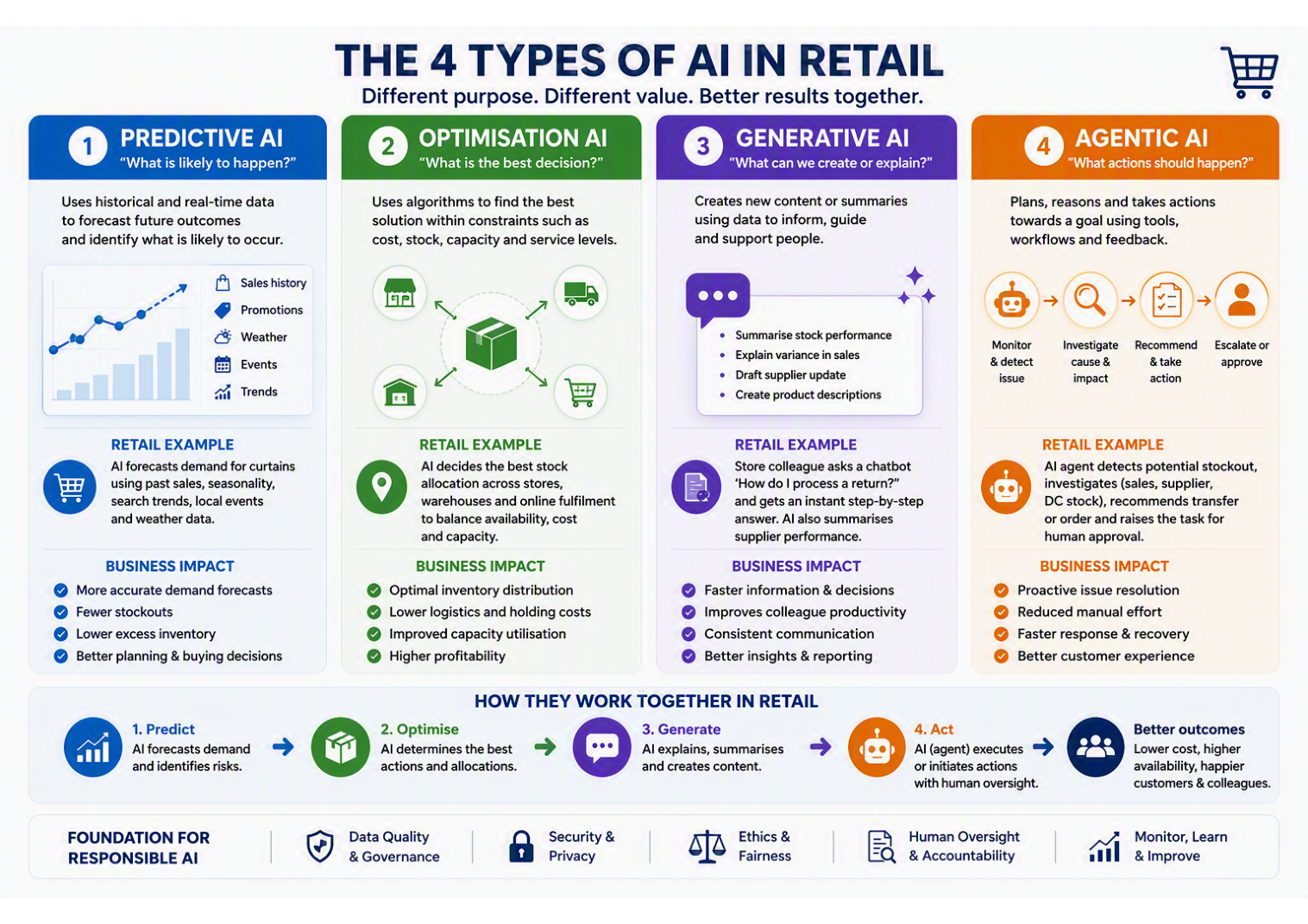
Artificial intelligence is often discussed as though it were a single capability. In practice, predictive, optimisation, generative and agentic AI solve different problems, answer different business questions and require different architectural approaches.
1. Predictive AI
What is likely to happen?
Predictive AI uses historical and real-time information to forecast future outcomes. In retail, relevant information may include sales history, promotions, seasonality, customer demand, search trends, weather and local events.
A retailer could use predictive AI to forecast demand for a product category. Potential value includes more accurate forecasts, fewer stockouts, lower excess inventory and earlier identification of operational risk.
2. Optimisation AI
What is the best available decision?
Optimisation AI identifies the most effective solution within constraints such as available stock, logistics cost, fulfilment capacity, warehouse throughput and service levels.
A retailer could use optimisation to determine how inventory should be allocated across stores, warehouses and digital fulfilment channels.
3. Generative AI
What can be created, summarised or explained?
Generative AI produces content or explanations using available information. It can summarise stock performance, explain sales variance, draft supplier communications, generate product descriptions and help colleagues follow approved procedures.
Outputs must remain grounded in trusted information and subject to appropriate controls.
4. Agentic AI
What actions should happen next?
Agentic AI can plan, reason and initiate actions towards a defined objective using connected tools, workflows and feedback.
An agent could identify a potential stockout, examine sales, supplier availability and distribution-centre stock, recommend a transfer or replenishment order, and raise an action for human approval.
How the four types work together
- Predict: forecast demand and identify risk.
- Optimise: determine the most effective response.
- Generate: explain the recommendation and evidence.
- Act: initiate the appropriate action with human oversight.
The architecture matters
Selecting an AI model is only one part of an enterprise AI capability. Organisations must also address data quality and ownership, integration, identity and access, security, privacy, decision authority, auditability, exception handling, operational monitoring and accountability.
Considering an AI-enabled retail capability?
Milo Magic Limited can help assess the use case, architecture, data, integration and governance required to move from experimentation towards a credible enterprise solution.
Arrange an initial consultation